
What to take away
- Track the data and permissions behind each supplier relationship.
- Reduce unnecessary fields and give historical records a retention owner.
- Match incident response to the actual information and access involved.
Your data does not stay inside your perimeter
A company can invest in its own application security and still discover that information it entrusted to a supplier has appeared somewhere it should not. The data may sit in a payroll platform, a recruitment service, an employee-benefits portal or a cloud application used by one department. The business relationship is familiar; the full path taken by the information is often much less visible.
That is the useful question behind TSMC's November employee-data disclosure. Instead of asking only whether the organization's own servers were breached, ask where copies of its information exist and who is responsible for protecting each one. Outsourcing a process changes who operates the system. It does not make the consequences of a data exposure disappear for the employees or customers whose records are involved.
For a smaller business, supplier security can sound like an enterprise procurement problem. In practice, it begins with ordinary decisions: what fields an export includes, which staff can download it, whether former employees remain in the dataset and what happens when the contract ends. These decisions are within reach of a growing company and can materially reduce how much information is available if something goes wrong.
What TSMC has actually disclosed
In a 12 November 2026 SEC filing, TSMC said that some current and former employee information had been made available on an external website without authorization. The company said the information matched data stored in a cloud service provider's system services. It reported no evidence that TSMC's own systems had been compromised and said the information was unrelated to operations or customer data. [1]
TSMC said it was notifying affected personnel and working with the supplier, investigating authorities and a third-party cybersecurity organization. The filing does not establish the precise entry point, the number of people affected or an attacker identity. Those gaps should remain gaps in our account. “No evidence of compromise” also describes an investigation's findings; it should not be rewritten as an absolute guarantee about every system. [1]
This article uses that limited public record as a starting point for our own supplier-risk analysis. The examples below are hypothetical and do not describe TSMC's internal processes. We are interested in the decisions that other businesses can make now, without needing private details of this investigation or assuming that their suppliers have suffered the same failure.
Map the information, not only the vendor names
A supplier register that lists company names and renewal dates is useful for procurement, but it does not fully explain exposure. Add the information each service holds and the reason it needs that information. Include the categories of people involved, the departments that provide the data and any integrations that keep it updated. A supplier used for one small workflow may still hold a large historical dataset.
Consider a hypothetical startup using separate services for recruitment, payroll and training. The training provider may need an employee reference and course completion status. Payroll may require considerably more sensitive information. If the same broad employee export is sent to both simply because it is convenient, the company has expanded exposure without improving the training service. The risk comes from the data flow, not from the supplier's place on an organizational chart.
Record the direction of access as well. Does the company upload a file, does the provider pull records through an API, or can its staff sign in to an internal portal? Does the integration have write access? A file transfer and a persistent privileged connection create different response requirements. An accurate map makes it possible to ask targeted questions and to withdraw the right access when the relationship changes.
Follow the data beyond your own application
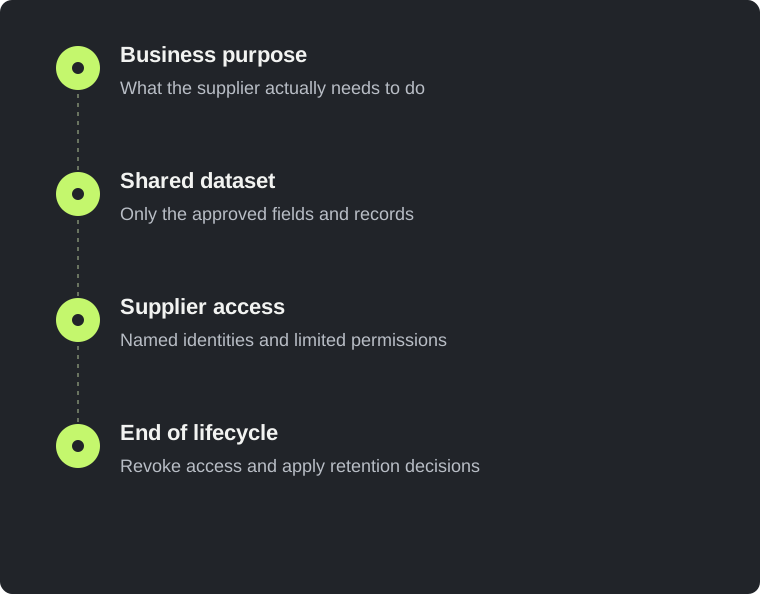
- Business purpose
What the supplier actually needs to do
- Shared dataset
Only the approved fields and records
- Supplier access
Named identities and limited permissions
- End of lifecycle
Revoke access and apply retention decisions
Match access to the job being performed
A supplier employee helping with a support issue may need different permissions from an automated payroll job or a customer administrator. Treat those identities separately. Shared accounts make it harder to understand who acted and to withdraw access when one person changes roles. Persistent privileges granted for a one-off support request can quietly become part of the normal system unless they have an owner and an expiry process.
For applications you build, OWASP's authorization guidance recommends least privilege, denying access by default and validating permissions on every request. These are general design principles, not a finding about the TSMC incident. Apply them to exports and background jobs as well as visible screens: a user who cannot view another department's records should not gain them through a bulk-download endpoint. [2]
Review what each integration can do without trusting its label. A token named reporting might have permission to read all employee records or create additional users. Ask for the actual scope and test the boundary with approved synthetic accounts. Where narrower permissions are unavailable, record the limitation and decide whether the business accepts it, changes the workflow or chooses a different service. An explicit decision is easier to manage than an undocumented assumption.
Historical data needs an owner too
Current records tend to attract attention because people use them every day. Historical records can become more difficult to manage: the original project ends, the account remains active and nobody is certain whether deletion would break a reporting obligation. The result may be several overlapping archives held by different suppliers, each containing people who have not worked with the company for years.
The answer is not indiscriminate deletion. Different records may need to be retained for legitimate business, contractual or legal reasons, and the requirements depend on context. Establish a retention decision for each dataset with the appropriate business and legal input. Record who owns it, what period applies and how deletion or archival is carried out. A generic policy is only useful when it translates into a working process in the actual service.
Ask what happens to derived copies, exports, backups and support attachments. A provider's delete button may apply to one visible record without answering every question about retained information. Obtain a clear explanation for the product and configuration you use. When a contract ends, include data return, access removal and the handling of retained copies in the closure process. The relationship should have a documented end state, rather than merely an expired invoice.
Ask questions that lead to an operational decision
A long security questionnaire can produce a folder of answers without changing how a service is used. Start with the information and access that matter to your workflow. Ask where the relevant data is stored, which identities can access it, how privileged support access is controlled and how the provider notifies customers of an incident. Ask what evidence is available for the specific service, rather than treating a broad certification logo as an answer to every question.
Then connect the answers to a decision. If the provider cannot restrict an integration to the required fields, can you prepare a smaller export yourself? If deletion requires a support request, who submits it and how is completion recorded? If incident notifications go only to the billing contact, should a technical owner be added? These are modest changes that can make an existing supplier relationship easier to control.
Keep the level of review proportionate. A vendor handling public marketing assets has a different risk profile from one holding employee identity documents or payment instructions. Prioritize the suppliers with the most consequential data or access, and revisit the assessment when the relationship expands. A service that began as a small trial may deserve another review when it becomes the central record for an entire department.
Respond to the actual information involved
When a supplier reports an incident, begin with the facts you need to act: affected account identifiers, the relevant time window, the data categories involved and whether access is continuing. Preserve the notification and verify it through a known channel. Identify the internal owner for the relationship and bring the appropriate security, operations and privacy expertise into the response.
Map the notice against your own records of what was shared. If the supplier says an export was involved, determine which version and fields it contained. If credentials may be exposed, establish what they could access and revoke or rotate them through a controlled process. If personal information was copied, a password change may be useful in some circumstances but cannot undo the disclosure. Different kinds of exposure require different actions.
Communicate with affected people using a factual account of what is known and what they can do. Avoid reassuring language that goes beyond the evidence. Equally, avoid treating an unverified criminal claim as an established fact. Notification duties and deadlines depend on the actual circumstances, contracts and applicable jurisdictions; obtain the appropriate advice rather than assuming that a generic international checklist decides them.
Give affected people guidance they can use
Employee information can be valuable to someone attempting impersonation, fraud or targeted phishing. The potential harm depends on the fields and context, so guidance should be specific. If contact details and employment context are involved, explain how to verify an unexpected message claiming to come from HR or a benefits provider. If a particular account is at risk, provide the official route for the necessary action.
Do not create another exposure while helping people. Avoid circulating full affected-record lists through broad email groups or asking employees to send identity documents to an improvised mailbox. Provide a controlled contact route and verify the identity of people requesting account-specific details. Support staff need a clear script for what they can disclose and when to escalate a request.
Be explicit about follow-up. Tell people whether the investigation is continuing, where updates will appear and how to report suspicious contact. A one-time notice that leaves every question unanswered pushes people toward rumours and unofficial advice. Good communication cannot reverse an exposure, but it can reduce confusion and help people make informed decisions without amplifying unsupported claims.
Test the part of the relationship you control
A focused assessment of your application can examine whether users and integrations receive only the data they are permitted to access. Tests can cover export endpoints, search results, document downloads and background jobs using representative accounts and synthetic records. The important question is whether the server enforces the intended boundary, including routes that are not visible in the normal interface.
For a multi-tenant service, define the role and ownership matrix before testing. A department manager, a payroll operator and an external support user may have different legitimate needs. The tester should verify both permitted and forbidden actions so that a fix does not simply break the workflow. Findings should include reproducible evidence, a specific impact and a remediation approach that developers can evaluate.
Testing your own system does not establish the security of a supplier's internal environment. A supplier assessment, contract review or independent assurance report answers different questions and has its own limits. A free external review of one approved domain is narrower still: it can identify visible exposure and help scope further work, but cannot prove how every external copy of employee information is protected. Clear boundaries make the eventual report more useful.
Turn supplier risk into a manageable first week
Choose one high-impact data flow rather than attempting to audit every supplier at once. Ask the business owner and a technical colleague to describe the task, list the fields shared and identify the access method. Compare that description with the actual export or integration configuration. Differences between intention and implementation are often the most useful findings, especially where the relationship has grown gradually.
Remove clearly unnecessary fields through the normal change process, confirm who owns the remaining access and document the revocation path. Establish how historical records are handled and where incident notices will go. If an important answer is missing, assign a specific follow-up to the supplier relationship owner. The output should be a small set of decisions and completed changes, not merely a newly created spreadsheet.
Repeat the exercise when a new supplier receives sensitive information or an existing one gains broader access. Your own systems remain important, but they are only part of the data's journey. A business that understands that journey can reduce unnecessary exposure, respond more accurately to a notice and explain its decisions to the people whose information it has been trusted to protect.
Sources & editorial notes
This analysis uses public reporting and the sources below. Confirmed facts are distinguished from our recommendations and hypothetical examples. We did not investigate these organisations’ systems. Code examples are educational and should be adapted and tested in an authorised environment.
- TSMC SEC filing — statement on unauthorized access of employee personal data
Primary company statement dated 12 November 2026; reviewed 19 November 2026.
- OWASP Authorization Cheat Sheet
General application-security guidance; not evidence of the entry point in this incident.
Incident accounts can change as investigations develop. This article reflects sources checked on 19 November 2026. Illustrations are conceptual; no affiliation or endorsement is implied.