What to take away
- Map the data and permissions behind every AI integration.
- Separate experiments from production access and rehearse credential revocation.
- A provider notice must be matched to your own accounts, data and dependencies.
Your AI integration is also a trust relationship
An AI feature often enters a business through a very small door: a developer tries an API, a team uploads a sample dataset, or a founder connects an assistant to a useful internal tool. The resulting product can feel lightweight even when the permissions behind it are substantial. An API key may unlock paid compute, private files, customer records, or an action that changes something in another system. A supplier incident can therefore become your incident without anyone first breaking into your website.
That is the business question raised by the Fireworks AI disclosures: what could someone reach if the service holding your data or credentials were compromised? The useful answer is a map of permissions, data and recovery steps. A list of approved AI vendors alone will not tell you which application stops working when a key is revoked, or which customer records were included in an evaluation dataset six months ago.
For a startup building quickly, the objective is not to avoid AI. It is to make the relationship understandable and reversible. You should be able to explain what you have shared, what the supplier can do with its credentials, who owns that decision and how you would withdraw access. Those are concrete engineering questions, and most can be answered before buying another security product.
What Fireworks has confirmed
Fireworks' 17 November 2026 bulletin distinguishes two incidents. In the first, spanning 3 August to 7 October, an unauthorized party used stolen Fireworks credentials and a service vulnerability; secrets, model files and datasets were accessed for a small number of customers. In the second, dated 23–30 October, access through development machines at a compromised cloud provider reached part of Fireworks' production systems. [1]
The company said the second incident affected account and billing information for accounts created before 30 October, with datasets, models and/or secrets accessed for a smaller subset. Payment-card numbers were excluded because Fireworks did not store them. Both incidents were described as contained and remediated, with the second forensic investigation continuing. These statements are the provider's account, not independent findings by PenTestRaptor. [1]
The distinction matters for readers assessing their own exposure. A public announcement describes the provider's investigation; an account-specific notification should establish the customer's relevant scope. Do not infer that every feature, every dataset or every downstream system was accessed. Equally, an earlier limited assessment should not override a subsequent update. Keep the date of the notice with your internal incident record so that decisions can be revisited when the evidence changes.
Follow the permission, not just the API request
Consider a hypothetical sales platform that uses an AI service to summarize customer conversations. Its team supplies a dataset for evaluation and a credential that lets the evaluation process fetch supporting records. The integration may begin with a harmless demonstration but gradually accumulate production access. Months later, nobody remembers whether the key is limited to reading a single dataset or can query the whole customer database.
There are several different questions hidden inside that situation. What data was uploaded and retained? What can the stored credential access now? What could it access at the time of an incident? Can the service create other credentials or delegate access? Does a development environment share identities with production? Each question changes the possible impact and the appropriate response. Rotating one key cannot recover a dataset that has already been copied.
A practical inventory therefore records actions as well as destinations. Instead of writing “uses AI provider,” record “sends redacted support conversations for summarization” and “stores a read-only token for the evaluation dataset.” Include the owner, environment, retention setting and revocation method. The exercise often exposes unnecessary access long before a technical test does. It also gives the sales team a more credible answer when a customer asks where their information goes.
Follow the trust your integration creates
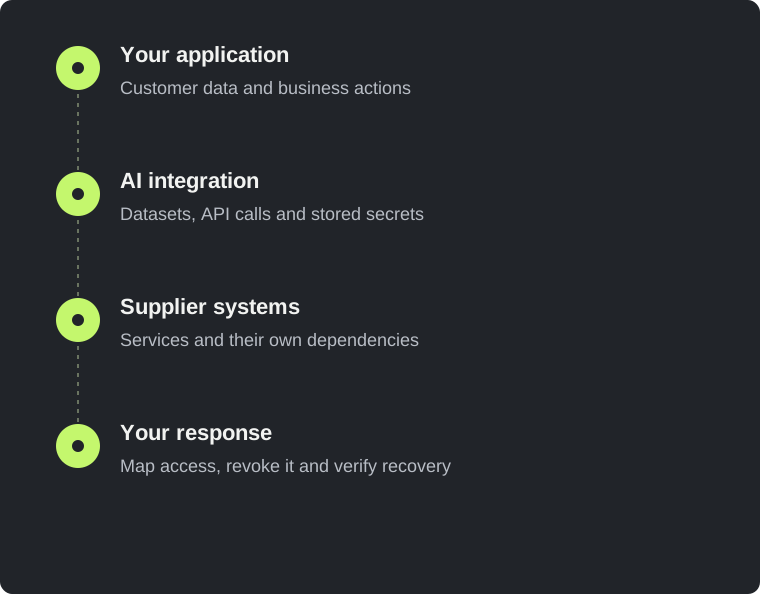
- Your application
Customer data and business actions
- AI integration
Datasets, API calls and stored secrets
- Supplier systems
Services and their own dependencies
- Your response
Map access, revoke it and verify recovery
Make credentials less valuable when they escape
A credential should represent a narrowly defined job. A summarization worker that only needs to read one dataset should not hold a general administrator token. Where the service supports it, separate projects, environments and permissions so that a test job cannot inherit production privileges by accident. OWASP's secrets-management guidance emphasizes managing secrets across their lifecycle, including access, rotation and revocation. The exact implementation depends on the systems involved. [2]
The most useful design review starts with the consequence of theft. Ask a developer to describe what an outsider could do with each integration credential, without relying on the outsider behaving like the intended application. If the answer includes exporting all customers, changing billing settings or creating a new privileged user, the credential deserves a stronger boundary. Reducing that boundary can produce more benefit than simply changing the same overpowered key more frequently.
Rotation also needs to be a working process. Identify the applications that use the old secret, create the replacement through the approved mechanism, update the consumers, verify the new path and revoke the old secret. Some incidents require immediate revocation before a graceful migration. Decide who can make that call and what service interruption the business can tolerate. Never paste live secrets into a support ticket, a shared document or an AI conversation to make the process easier.
A small integration contract beats an undocumented exception
The example below is an illustrative configuration contract for your own application. It is not a Fireworks configuration file and does not enforce permissions by itself. Its purpose is to make the intended security boundary visible in code review. Actual restrictions must exist in the provider's access controls and in your application, rather than only in a document that says access is limited.
A useful contract names the business owner, identifies the approved dataset and makes production access an explicit decision. The retention field should refer to a verified setting or agreement, not a developer's assumption. A token reference should point to a secret manager entry; the token itself does not belong in the repository. Reviewers can then compare the intended relationship with the permissions that are really deployed.
Treat changes to this contract as product changes. Moving from synthetic data to customer transcripts, enabling a new connector or expanding from one workspace to all customers can materially change the risk. Those changes deserve a clear owner and a test. Keep an exception process for legitimate needs, with an expiry date and a reason, so that a temporary experiment does not quietly become permanent infrastructure.
integration: support-summary-evaluation
owner: product-engineering
environment: staging
approved_data: synthetic-support-conversations
secret_reference: secret-manager://staging/summary-reader
allowed_actions:
  - read:approved-evaluation-dataset
production_access: false
retention_review: required-before-real-data
revocation_runbook: runbooks/revoke-summary-access.md
review_on:
  - new-data-category
  - new-permission
- new-subprocessorKeep experiments away from production authority
Development machines are convenient places to store broad access because developers need to diagnose problems quickly. The danger is that convenience can create an unexpected route into production. A laptop, evaluation runner or temporary virtual machine may end up holding deployment credentials, database connection strings and support access at the same time. An attacker who reaches that machine inherits a much richer starting point than the machine's name suggests.
For a smaller team, separation can begin with a few deliberate decisions. Use different identities for development and production. Supply synthetic records to experiments unless there is an approved reason for real data. Require a separate authorization step for production actions. Remove access when a project ends, including the forgotten service accounts created to make a demonstration work. These controls should follow the identity and workload, rather than depend on everyone remembering which terminal window they opened.
Make support access equally explicit. A provider may need temporary access to diagnose a difficult issue, but the access should have a defined purpose, an owner and a way to expire. Record what was granted and confirm its removal. The same discipline helps when an engineer leaves, an agency finishes a contract or an integration is replaced. Security improves when the system makes the intended boundary easy to see and difficult to bypass casually.
Treat datasets as business records
Teams often classify a training or evaluation dataset by its technical purpose rather than by its contents. A file called test-data can still contain real names, emails, support messages and commercially sensitive notes. Copying those records into another environment does not make them less sensitive. It creates another copy that needs an owner, an access policy and an eventual deletion decision.
Before uploading a dataset, ask what the task actually requires. A formatting test may need representative structure but no real customer information. A performance experiment may need realistic lengths and distributions without authentic identities. A quality evaluation may justify selected real examples, but that should be an intentional decision with appropriate controls. Prefer the smallest useful dataset and avoid bundling fields simply because an export button includes them by default.
Deletion deserves its own verification. Removing a dataset from the application's interface may not answer questions about retained versions, logs, backups or derived artifacts. Ask the supplier what deletion means for the specific product and account configuration. Record the response rather than making universal assumptions about all AI services. This is also a good moment to check whether internal teams have downloaded extra copies to notebooks, shared folders or personal development environments.
What to do when your provider sends a breach notice
Start by preserving the notice and establishing its authenticity through a known provider channel. Assign one internal owner to coordinate the response. Collect the affected account identifiers, the stated time window and the categories of information involved. Ask focused questions where the notice is unclear. A provider can usually respond more usefully to a specific resource identifier than to a broad request to confirm that everything is safe.
Next, map the notice to your inventory. Identify exposed or potentially exposed credentials, the systems they could reach and the people responsible for those systems. Revoke or rotate access according to the incident's urgency and your tested procedure. Review relevant logs for use of the affected identities and preserve the evidence before normal retention removes it. Absence of an alert is not proof that no access occurred, particularly where logging was incomplete.
Keep containment and communication connected. Customer support needs a factual statement about what is known and what remains under investigation. Leadership needs to know which services may be interrupted by credential changes. Any notification obligations require a separate assessment of the actual data, contracts and jurisdictions involved; a blog checklist cannot decide them. Record the rationale for each important decision so that later findings can refine the response without rewriting its history.
What a focused security assessment can establish
A well-scoped web or API assessment can test whether the application's own authorization boundaries behave as intended. For example, can a user in one workspace access another workspace's evaluation files? Can a low-privilege account invoke an administrative integration endpoint? Can an application action reveal a stored credential in an error response or exported configuration? These are concrete questions that can be investigated with authorized test accounts and synthetic data.
Testing should follow the whole workflow. A front-end permission check may look correct while a background export, callback or bulk action uses a different route. The assessor needs to understand which identities the application uses for these actions and where a user's authority is checked. Findings should demonstrate a specific boundary failure and its impact, rather than present a list of speculative attack chains that were never validated.
There are limits. An external review of your domain cannot establish the security of a provider's internal development machines or prove that a supplier has never been breached. A broader integration or architecture review requires additional scope and information. The useful outcome is an honest account of what was checked, what the evidence supports and which questions remain. That gives the business a defensible next step instead of a vague declaration that its AI stack is secure.
A practical plan for the next working week
Begin with the integrations closest to valuable information or business authority. Ask each product owner to identify the AI services they use, the datasets they have uploaded and the credentials they have provided. Do not wait for a perfect inventory tool. A short, maintained record with named owners is more useful than a comprehensive spreadsheet that nobody trusts. Resolve disagreements about ownership before an incident makes them urgent.
Choose one integration and rehearse its exit path. Can the team revoke access, replace the credential and verify that the product still behaves correctly? Can it identify the records shared with the provider? Can support describe the temporary impact without inventing a recovery time? Capture the gaps as specific engineering tasks, with a person and a completion condition for each. Repeat the exercise for the next most consequential integration.
Finally, connect the work to product delivery. Make new data categories and new permissions visible in release reviews. Give developers a straightforward way to request legitimate access, and a reliable way to remove it later. The goal is to keep useful automation while reducing the amount of trust hidden inside it. When your next AI feature launches, the team should understand both what it can do for customers and what someone could do if its credentials ended up in the wrong hands.
Sources & editorial notes
This analysis uses public reporting and the sources below. Confirmed facts are distinguished from our recommendations and hypothetical examples. We did not investigate these organisations’ systems. Code examples are educational and should be adapted and tested in an authorised environment.
- Fireworks AI security bulletins — 17 November update
Primary provider account; distinguishes two incidents. Reviewed 19 November 2026.
- OWASP Secrets Management Cheat Sheet
General defensive guidance, not evidence about the Fireworks incident.
Incident accounts can change as investigations develop. This article reflects sources checked on 19 November 2026. Illustrations are conceptual; no affiliation or endorsement is implied.