
What to take away
- Map authentication and administrator access alongside application hosting.
- Use bounded retries and deliberate degraded states rather than emergency bypasses.
- Test a recovery path against a specific business objective.
The server can be healthy while the business is stuck
A customer presses Sign in and gets an error. Your application servers are running, the database is responding and the hosting dashboard looks mostly green. From the customer's perspective, none of that matters: they cannot use the product. Availability is determined by the complete journey, including the services that issue identities, route requests and allow your team to make repairs.
This is why a cloud outage can be difficult to explain to a nontechnical stakeholder. “We host on AWS” describes a supplier relationship, not a single machine with a single failure mode. A product may depend on several regional and global services, while its administrators use another set of tools to manage them. Some failures affect customer traffic; others affect the ability to sign in, deploy a fix or provision replacement infrastructure.
The 15 November AWS disruption offers a useful prompt to examine those dependencies. The question for a smaller business is not whether it can build a second Amazon. It is which customer actions must continue, which can safely wait and whether the people responding to an incident can reach the controls they need. A clear answer is often more valuable than an expensive redundancy project designed around the wrong failure.
What the AWS notice establishes
AWS reported authentication, signup and connectivity problems in US-East-1 on 15 November 2026. Its resolved update described an overall impact window beginning at 03:05 PST, with most services recovering after authentication mitigation and a narrower network-load-balancer impact continuing until 06:21 PST. IAM Identity Center and services depending on it were among the affected paths. [1]
The notice described a subset of Network Load Balancers in one cell of one availability zone, rather than failure of every workload in the region. It did not explain a root cause in the update reviewed for this article. We therefore classify this as an outage with the cause not established here, and do not attribute it to a cyberattack or connect it to unrelated incidents. [1]
That distinction should shape your own incident review. Use the provider record to understand the service scope and compare it with your timestamps. Do not assume that every error during the same morning had the same cause. Your application may also have had an independent bug, a misconfigured retry loop or a local permission problem. Keep those hypotheses separate until logs and request traces support a connection.
Map the journey that actually earns revenue
Start with a customer action, not an infrastructure inventory. For an online booking company, the important journey might be selecting an appointment, confirming availability, paying and receiving a confirmation. For a business dashboard, it might be signing in and retrieving a report before a meeting. Draw the services required for each step and mark which ones must respond immediately.
A hypothetical Philippine software startup might discover that an otherwise available dashboard still needs an external identity provider for every new session, a separate email service for login links and a cloud console for emergency deployment. The application is spread across several servers, but the customer's first step still depends on one narrow path. This is an illustrative architecture, not a claim about any AWS customer affected in November.
Add the administrator's journey to the same exercise. How does the on-call engineer receive an alert? Where is the runbook stored? What identity is needed to read secrets, change traffic routing or contact support? A plan that assumes access to the failed dependency may work beautifully on paper and fail immediately in practice. Record the dependency honestly before deciding whether to remove it, tolerate it or build a tested alternative.
Availability is a complete journey
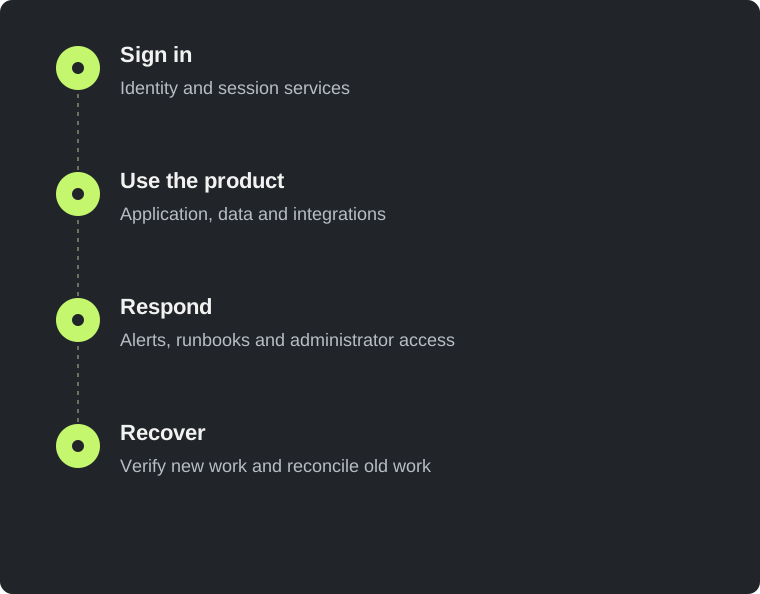
- Sign in
Identity and session services
- Use the product
Application, data and integrations
- Respond
Alerts, runbooks and administrator access
- Recover
Verify new work and reconcile old work
Decide what can safely keep working
A degraded service can still be useful when its limitations are clear. A customer may be able to view a previously generated report even if new report generation is delayed. A storefront can display products while disabling checkout that cannot reliably confirm payment. An internal dashboard can show the last successful refresh with its timestamp rather than silently presenting stale figures as current.
The design depends on the sensitivity of the action. Never turn an authentication failure into permission to bypass authentication. Never accept an order as completed if its payment or stock reservation is uncertain. A safe fallback preserves the business rules that matter, while explaining which capabilities are temporarily unavailable. Some actions should stop entirely until their dependencies recover.
Write these decisions down before the incident. Product, engineering and support should agree what customers see, what data is considered fresh enough and what happens to work already in progress. Include cancellation and duplicate-handling behaviour. A queue that accepts work without a clear completion or expiry rule can convert a short outage into days of reconciliation. Degradation should be a designed product state with an exit path, not a collection of emergency exceptions that persist after recovery.
A retry is another request, not a recovery plan
When a dependency is slow, repeatedly asking it to try again can make matters worse. Requests consume connections, memory and processing time while they wait. If every client repeats at the same interval, recovery can arrive with a wave of synchronized traffic. Amazon's guidance recommends timeouts, restrained retries and backoff with jitter to avoid magnifying transient failures; operations with side effects also require care over whether a retry is safe. [2]
For your application, begin by identifying the deadline for the customer action. A request that takes thirty seconds is not acceptable simply because five internal calls each have a six-second timeout. The whole operation needs a budget. Decide which layer is responsible for retrying so that retries in several services do not multiply one another unexpectedly. Log enough information to distinguish the first attempt from subsequent ones.
The example below only calculates a bounded delay schedule. It sends no traffic and is not a replacement for your SDK's supported retry configuration. In a real implementation, consider the remaining deadline, the provider's Retry-After instruction, cancellation and the operation's idempotency. A payment request that timed out may already have succeeded; resending it blindly can create a second charge. Recovery behaviour must respect the meaning of the operation, not just its HTTP status.
import random

def retry_delays(attempts=4, base_seconds=0.25, cap_seconds=2.0):
    """Illustrative only: a caller must also enforce an overall deadline."""
    for attempt in range(attempts):
        ceiling = min(cap_seconds, base_seconds * (2 ** attempt))
        yield random.uniform(0, ceiling)

for number, delay in enumerate(retry_delays(), start=1):
    print(f"Retry {number}: wait up to this sampled delay: {delay:.2f}s")

# Before implementing retries, decide:
# - Is this operation safe to repeat?
# - Does a supported SDK already retry it?
# - Has the overall customer-request deadline expired?Protect the path your responders will need
Administrative access deserves a recovery design of its own. A second account is not automatically an independent route if it uses the same identity service, device, network and approval workflow as the first. Map those dependencies explicitly. The objective is to avoid avoidable lockouts while keeping emergency access tightly controlled, monitored and limited to people who genuinely need it.
An emergency account also cannot repair a failed provider service by magic. If the relevant control plane is unavailable, different credentials may encounter exactly the same limitation. Distinguish a problem in your own access configuration from a provider outage before choosing a response. That distinction prevents teams from weakening authentication settings in a hurry and discovering later that the change could never have solved the incident.
For a small team, a useful rehearsal is simple: ask the designated responder to find the runbook, verify their approved access method and identify the person who can authorize a disruptive recovery action. Do this without relying on the primary chat or email platform. Use a controlled exercise, not a surprise production lockout. Record where the process depends on one founder, one phone or one password manager session, and remove those fragile assumptions in a planned way.
Buy redundancy for a specific failure
Multiple servers help with some failures. Multiple availability zones help with others. A second region introduces another set of tradeoffs, including data replication, traffic routing, operational complexity and the time needed to make the alternative ready. None of these arrangements should be described as a universal guarantee. The right question is which failure the design has actually been tested to survive.
Before adding another region, agree a recovery objective in business terms. How long can the booking system be unavailable? How much recently entered data could the company tolerate losing? Which functions must return first? The answers determine whether a warm standby, a simpler restore process or a temporary manual workflow is appropriate. A complicated design that the team cannot operate can be less useful than a modest, well-rehearsed recovery path.
Test the entire path, including dependencies that are easy to miss. Can the alternate environment obtain its configuration and secrets? Does it have enough capacity? Are integrations, payment callbacks and allowlists prepared for the new location? Does the support team know how to tell customers which actions are safe? A failover demonstration should record these details and its elapsed time, rather than stop when a replacement server answers a health check.
Monitor the business action and the dependency separately
Infrastructure monitoring answers questions about the components you operate. A synthetic customer check answers a different question: can a representative user complete an approved journey? Both are useful. A healthy CPU graph cannot prove that a new session can authenticate, and a failed login check cannot by itself identify which supplier is responsible.
Use low-impact synthetic accounts and clearly defined checks. Avoid generating real orders, sending customer emails or repeatedly submitting payment requests just to prove availability. Where a complete transaction is necessary, create a dedicated safe route with explicit cleanup and spending limits. Record the stage that failed and the time of the last success. Keep monitoring credentials narrow and avoid placing sensitive information in alert messages.
Your alert should help the responder make a decision. “Authentication error rate exceeded threshold” is more useful when it identifies the affected journey and links to the relevant dependency record. Separate internal diagnostic notes from customer-facing updates. During an outage, publish what users can and cannot do, the next update time and any safe workaround. Do not promise a restoration time simply because a provider has begun investigating; your own downstream recovery may continue after its status returns to normal.
Recovery includes the work that accumulated
When the provider reports recovery, the business may still have a queue of failed jobs, delayed notifications and customers who tried several times. Treat restoration as a controlled phase. Confirm that new requests succeed, then examine work created during the impact window. Identify duplicates, partial transactions and tasks that exceeded their useful lifetime before replaying them.
A hypothetical invoicing application illustrates the problem. Generating the same invoice twice might be harmless if the operation is designed to return the existing record. Sending the same payment reminder five times can damage customer trust even if no money moves. Replaying a stale stock reservation may prevent a new customer from buying an available product. The correct recovery rule depends on the business action and cannot be inferred from a generic job status.
Give support a reconciliation guide. It should explain how to recognize an uncertain result, where to check the authoritative record and when to escalate instead of guessing. Preserve the incident timeline while it is still fresh. After normal service returns, review what the team learned about dependencies and response authority. A short list of completed improvements is more valuable than a long postmortem whose recommendations never receive an owner.
Ask suppliers questions you can act on
A useful supplier conversation begins with your dependency map. Ask whether the feature you use depends on a particular region, identity service or administrative control plane. Ask how the supplier communicates partial recovery and whether account-specific notices contain information that a public dashboard cannot show. Keep the answers with the integration record, and assign someone to revisit them when the product changes. A service description from the original procurement call may no longer match the feature your team uses today.
Avoid turning that conversation into a demand for an impossible guarantee of uninterrupted service. Instead, establish the available recovery options, the limits of support and the decisions that remain your responsibility. Your own customers will benefit more from a clear explanation of a tested workaround than from a supplier assurance that nobody has translated into an operating procedure. Those details also make renewal decisions more informed: reliability is partly a product capability and partly the work needed to use it well.
Where security testing helps—and where it stops
Availability and security overlap when an application's behaviour under stress weakens its access controls or exposes information. A focused assessment can examine whether an error reveals a secret, whether an expired session is incorrectly accepted or whether a recovery endpoint allows an unauthorized action. Those questions belong in a written scope with safe limits and representative test accounts.
A standard external security review does not establish that your cloud architecture can survive a regional outage. Load testing, failover exercises and disaster-recovery validation require different preparation, access and operational safeguards. They should be commissioned deliberately. Calling every activity a pentest makes it harder for the buyer to understand what evidence they will receive and which important questions will remain unanswered.
For your next planning meeting, bring three things: a map of one revenue-critical journey, the recovery objective for that journey and the result of a small controlled rehearsal. Use the gaps to choose the next piece of work. If the concern is your public application or API exposure, a bounded external review can establish a useful starting point. If the concern is cloud continuity, begin with the dependencies and recovery process. Both deserve attention, and each deserves an honest scope.
Sources & editorial notes
This analysis uses public reporting and the sources below. Confirmed facts are distinguished from our recommendations and hypothetical examples. We did not investigate these organisations’ systems. Code examples are educational and should be adapted and tested in an authorised environment.
- AWS Health — US-East-1 connectivity incident, 15 November 2026
Primary provider status record. No root cause asserted in the notice reviewed 19 November 2026.
- Amazon Builders’ Library — timeouts, retries and backoff with jitter
General engineering guidance; not a postmortem of this incident.
Incident accounts can change as investigations develop. This article reflects sources checked on 19 November 2026. Illustrations are conceptual; no affiliation or endorsement is implied.