
What to take away
- Names, contact details and order history can enable convincing fraud even without payment-card information.
- The disclosed maximum refers to potentially exposed records, not a confirmed count of unique affected people.
- Test customer, staff and export permissions using synthetic records; do not infer the incident’s entry point from its outcome.
What the company disclosed—and what it did not
Nitori Holdings reported on 9 November 2026 that it had detected unauthorized access on 6 November. Its investigation identified the possibility that up to 37.62 million records had leaked. Potentially affected categories included customer contact and membership information, business contacts and order information. The company said login passwords and payment-card information were outside the potentially leaked categories. The scope and route of access remained under investigation. [1]
That wording is important. A maximum number of records is not necessarily a count of unique people, and a potential leak is not the same as a verified inventory of every item taken. The notice also did not establish a specific application vulnerability. We should not turn a large number into an invented technical explanation. [1]
For an ecommerce founder, however, the business lesson does not require knowing the final entry point. Customer information has value beyond taking a payment. Names, email addresses, delivery details and purchase context can make a fraudulent message feel familiar. They also represent information customers entrusted to a business for a particular purpose. The absence of card data does not make that trust irrelevant.
This article uses the disclosure as a prompt to examine a typical online business. The scenarios and code are illustrative; they are not a reconstruction of Nitori’s systems. The aim is to help a smaller company identify where customer information accumulates and how to check whether the right people—and only those people—can retrieve it.
Why ordinary details can make a convincing scam
Imagine a hypothetical customer who ordered a desk from a small online retailer in Manila. A message arrives the following week with the correct item description, delivery address and order reference. It claims the courier needs a small additional payment. None of those details proves the sender is legitimate, but together they give the message a plausible story. That is why purchase context deserves protection even when the merchant never stores card numbers.
The same information can make a support interaction harder to assess. A caller who knows an address and recent purchase may sound like the genuine customer while asking to change a delivery destination or account email. If the support team treats knowledge of those facts as sufficient proof of identity, information collected to fulfill an order becomes a route to additional authority. This is a hypothetical risk, not a claim about what happened after the Nitori incident.
Design customer support around that distinction. Information can help locate a record without authorizing a sensitive change. A staff member may use an order reference to find the right account, then follow a separate verification process before changing the payment destination or releasing additional personal information. The exact process should match the business and the potential harm of the action.
Customer communications should reinforce the same separation. Explain which channels the business uses and how a person can verify an unusual request through a route they already trust. Avoid teaching customers that a message is authentic merely because it knows their name. A good response reduces the opportunity for follow-on fraud without blaming the customer for trusting details that appear accurate.
Find the copies beyond your main database
Start by following one customer record through its normal lifecycle. Where does the signup form send it? Which system creates the order? Does a fulfillment provider receive an export? Is a spreadsheet downloaded for customer support? Are order details copied into email, analytics events or a marketing platform? The main application database is often only one of several places where the same information exists.
Document the purpose of each copy. A courier may need a delivery address, while a marketing tool may need only an email address and an agreed preference. A developer investigating a checkout issue may need synthetic examples rather than an entire production export. Matching data to purpose helps reveal where convenience has expanded access beyond the task that justified it.
Include temporary locations in the exercise. Download folders, shared drives, test environments and support attachments can outlive the immediate problem they were created to solve. A file called “orders-final.csv” does not carry its own expiry date. Assign a person responsible for the export, specify the approved destination and decide when it should be removed or replaced with a less detailed record.
The useful output is a data-flow map a small team can understand. It should identify categories, destinations, owners and permissions without reproducing real customer data. If nobody can explain why a system receives a particular field, that is a worthwhile review item. You do not need to prove that the system is vulnerable before asking whether it should have the information at all.
Follow the customer record, not just the checkout
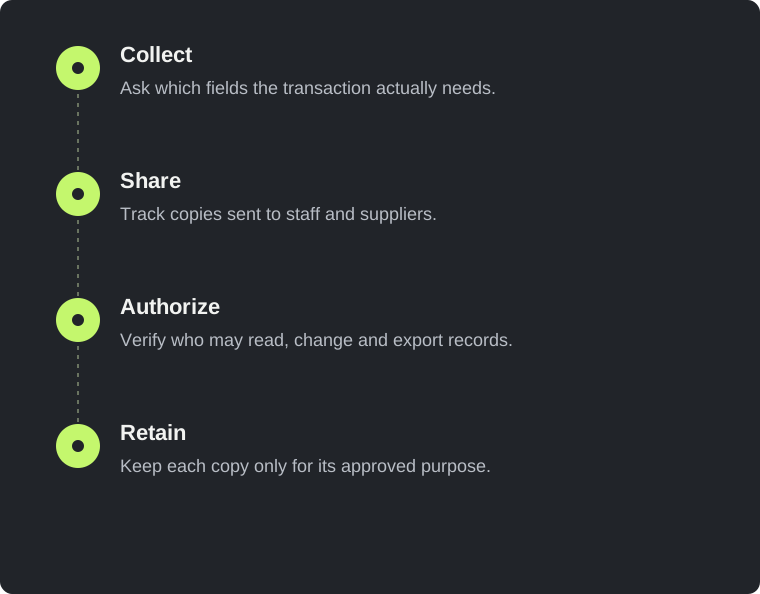
- Collect
Ask which fields the transaction actually needs.
- Share
Track copies sent to staff and suppliers.
- Authorize
Verify who may read, change and export records.
- Retain
Keep each copy only for its approved purpose.
A login is only the first question
Authentication establishes who is calling; authorization determines what that caller may do. A signed-in customer should not gain access to another customer’s order simply because they know its identifier. A support agent may need to see shipping status without exporting the entire customer base. A finance role may need invoices while having no reason to change account recovery settings.
OWASP recommends denying access by default and checking permissions for each request on the server side. It also recommends tests that exercise authorization rules. [2] For a business, the first task is to write those rules in ordinary language. Developers cannot reliably implement a customer boundary that nobody has defined, especially when staff roles and multi-company accounts overlap.
The fictional Python example below shows a minimal customer-order rule and two local tests. It does not access a website, reproduce a real vulnerability or represent a complete production security design. Its purpose is to make the business expectation explicit: the correct customer can read an order, and a different customer cannot. Real applications need the equivalent behavior enforced in their actual request and data-access paths.
Expand that thinking beyond the detail page. Search, exports, attachments, mobile endpoints and background jobs may expose the same record through different routes. Testing one page successfully does not establish that every path applies the same rule. Include permitted and denied actions for representative roles, using synthetic records and an agreed environment. The most useful result is evidence tied to the actual workflow.
import unittest

ORDERS = {"demo-001": {"customer_id": "customer-a", "item": "desk"}}

def read_order(customer_id, order_id):
    order = ORDERS.get(order_id)
    if order is None or order["customer_id"] != customer_id:
        raise PermissionError("Order unavailable")
    return {"item": order["item"]}

class OrderAccessTests(unittest.TestCase):
    def test_owner_can_read(self):
        self.assertEqual(read_order("customer-a", "demo-001"),
                         {"item": "desk"})

    def test_other_customer_cannot_read(self):
        with self.assertRaises(PermissionError):
            read_order("customer-b", "demo-001")

if __name__ == "__main__":
unittest.main()Exports deserve their own access review
A dashboard may reveal one record at a time while an export produces thousands. That difference changes the potential consequence of a mistake or misused account. Treat export capability as a distinct permission with a business reason, not an automatic companion to viewing a customer record. Ask who needs bulk access, which fields they require and how the resulting file is protected.
Consider a hypothetical support team that occasionally exports open delivery cases. It may need the order reference, current shipping status and a contact route. It may not need every customer’s date of birth or historical purchases. A narrower report can serve the task while reducing the information exposed if the file is misdirected or a staff account is compromised. This is a design choice the business can make before a pentest begins.
Background exports need review too. A request may be authorized when a job is created, but the user’s role can change before the file is ready. The download route still needs an appropriate permission decision. A long-lived public link should not silently replace the original access boundary. The exact implementation depends on the application, but the question remains simple: who can obtain this file now?
Record meaningful export activity without logging the exported data itself. Useful evidence may include the actor, approved organization, purpose, time, number of records and destination class. Large or unusual exports should be explainable in context. An alert alone cannot distinguish a legitimate month-end process from misuse; it needs an owner who understands normal business activity and can investigate exceptions.
Keep information because you need it, not because storage is cheap
Retention decisions should start with the function the information serves. An address may be needed for fulfillment and after-sales support. An invoice may need to remain available for accounting purposes. A temporary troubleshooting export may have no purpose after the issue is resolved. Those are different records with different reasons to exist, and treating them as one permanent archive makes control harder.
Avoid arbitrary deletion promises. Business, contractual and legal requirements vary, and the appropriate person should review them before a retention rule is implemented. The security task is to make the question visible and enforce the resulting decision consistently. A retention policy that exists only in a document will not remove a forgotten backup of a support spreadsheet from a shared folder.
Where detailed information is no longer needed for ordinary work, consider whether a reduced record can serve the remaining purpose. A product team measuring monthly demand may need aggregate totals rather than names and home addresses. A support trend report may need issue categories rather than full ticket conversations. Check whether the reduced output can still identify people through combinations of fields; removing a name alone is not a universal anonymization method.
Make retention part of product development. When a new feature collects another field, ask who uses it and when it stops being useful. When an integration is added, ask whether the recipient keeps its own copy and how deletion requests are handled. These decisions are easier before a dataset grows than after an incident forces the team to explain why years of information were retained.
Prepare to answer what was accessed
During an incident, a business needs more than the knowledge that a login occurred. It may need to determine which records were retrieved, whether exports were generated and which accounts or services were involved. Plan that evidence before an emergency. The appropriate detail depends on the application’s sensitivity, but the goal is to reconstruct significant actions without creating an unnecessary copy of customer content in the logs.
Choose event names and identifiers that are understandable to the people who will investigate. A generic “request succeeded” entry may not explain whether a person viewed one order or generated an entire customer export. Include enough context to distinguish the operation, the actor and the relevant organization. Protect the logs themselves because they may contain account identifiers and operational information that deserves restricted access.
Test the evidence with synthetic activity. Have an approved test user view a sample order, request an export and attempt a denied action in the agreed environment. Then ask whether the records tell the expected story. This checks the practical outcome rather than the existence of a logging checkbox. Also establish who can retrieve the evidence and how long it remains available.
Do not turn incomplete logs into certainty. If the application never recorded a particular action, the absence of that event cannot establish that it did not occur. Reports should explain the evidence available and the limits it creates. That honesty is useful to decision-makers, who need to distinguish a confirmed boundary from an unanswered question when choosing the next response step.
Explain the customer impact in precise language
A customer-facing statement should distinguish what is confirmed, what is possible and what remains under investigation. Those categories can change as evidence improves. A large maximum estimate may be appropriate early in an investigation, but it should not be described as a final count of affected people unless the evidence supports that conclusion. Precision helps customers understand what the business knows without making premature promises.
Explain the categories of information involved in language a customer can use. “Personal information” may be too broad to guide action. A delivery address, an email address and a password create different concerns. Equally, a statement that payment cards were not involved should not obscure the practical value of other exposed details. The relevant question is what a customer should watch for and how to verify unusual contact.
Keep the verification route simple. Direct customers to an established website or support channel they can reach independently. Coordinate support scripts so staff do not improvise conflicting explanations. If the business changes its guidance, date the update and explain what changed. This is communication planning, not a substitute for qualified advice about any notification obligations that apply to the organization.
Internally, decide who approves public facts and who owns follow-up questions. A small team can do this without a large communications department. What matters is that technical findings, customer support and business leadership share the same current account. Confident wording unsupported by evidence can create additional confusion just when customers most need a dependable source.
A practical starting point for a growing online business
Choose one customer journey and trace it end to end. Signup, purchase, delivery and support often provide a useful first slice. List the data collected, the systems that receive it and the roles that can retrieve it. Mark the paths you have verified and the ones you are assuming. That distinction gives the next technical review a concrete purpose.
Then prioritize boundaries with meaningful consequences: one customer accessing another’s records, a low-privilege staff member exporting everything or a retired integration retaining unnecessary access. A scoped web and API assessment can test those questions with representative accounts and synthetic data. It should produce evidence, practical fixes and a clear record of what was excluded. It should not claim to establish the security of every system in the business.
A free external review can help identify visible exposure on one approved domain and frame the next discussion. It does not include a complete internal data inventory or authenticated access-control assessment. The value is a sensible first step: understand what can be observed, decide what needs deeper testing and give customer-data protection a specific owner and plan.
Sources & editorial notes
This analysis uses public reporting and the sources below. Confirmed facts are distinguished from our recommendations and hypothetical examples. We did not investigate these organisations’ systems. Code examples are educational and should be adapted and tested in an authorised environment.
- Nitori Holdings: notice of potential personal-information leakage, 9 November 2026
Primary Japanese-language notice. Scope and entry route remained under investigation; English descriptions here are paraphrases.
- OWASP Authorization Cheat Sheet
General guidance supporting server-side permission checks and authorization testing; not a finding about Nitori.
Incident accounts can change as investigations develop. This article reflects sources checked on 19 November 2026. Illustrations are conceptual; no affiliation or endorsement is implied.