
What to take away
- Define a change by the business services it could affect.
- Agree observation, stop conditions and a rehearsed rollback before work starts.
- Separate reported facts from speculation while an investigation continues.
A routine change can become a business-wide event
Most businesses do not operate an air-traffic network, but they recognize the pattern: a routine infrastructure change begins, an unexpected behaviour appears and several teams discover that their systems depend on the same underlying component. The original task may have looked small. Its consequences are determined by the connections around it, not by the size of the device or the length of the maintenance ticket.
The November FAA ground stop is useful to examine because it makes availability tangible. When a critical system becomes unreliable, the safe response may be to stop work that depends on it. An online shop, a clinic or a logistics company faces a different level of risk, but it still needs to decide which actions remain safe when information or communications become uncertain.
The lesson is not that businesses should freeze every system in its current state. Old infrastructure needs maintenance, and delaying necessary improvements creates its own risks. The question is how to make change observable, reversible and limited in impact. A good change process helps the person doing the work understand the surrounding system, gives them clear stop conditions and ensures that someone is watching the business outcomes while the change takes place.
What officials have said, and what remains open
On 13 November 2026, telecommunications problems affecting air-traffic communications and radar led the FAA to issue a nationwide ground stop. In its 17 November update, the US Department of Transportation described a newly installed router broadcasting traffic that overloaded the network. Officials said they had reproduced the behaviour but had not yet established the precise root cause. [1]
The same update reported that national-security agencies had advised officials that the event was not a hack. We therefore treat it as an operational outage, with the technical explanation still developing, rather than inventing a cyberattack narrative. This article does not claim that a particular router setting, protocol defect or contractor action has been conclusively established as the underlying cause. [1]
A responsible incident article needs that boundary. It is possible to discuss change management and containment without pretending to possess an internal forensic report. The recommendations below are our analysis for smaller organizations, not a reconstruction of the FAA network. As a reader, keep the same distinction in your own postmortems: observations, plausible explanations and verified causes belong in separate parts of the record.
Define the change by its possible effect
A maintenance ticket that says “replace router” describes an action but not its risk. A useful ticket also identifies what connects through the device, what traffic it can introduce, which business processes depend on it and how the team will recognize an abnormal result. The same principle applies to a firewall rule, an identity-policy change, a database migration or a new version of a background worker.
Consider a hypothetical booking business with one gateway shared by its public website, staff dashboard and payment callbacks. Replacing that gateway could affect all three journeys even if the maintenance team thinks of it as a website task. The business should know whether existing bookings remain visible, whether payment confirmations can be delayed safely and whether staff can reach the recovery console if the normal route fails.
Scope should therefore include the failure paths, not only the intended path. Ask what happens if the device is reachable but behaves incorrectly, if it works for some connections but not others, or if it produces much more traffic than expected. These questions do not require predicting every possible defect. They help identify where a local problem could spread and which observations would justify stopping the change.
Make change observable and reversible
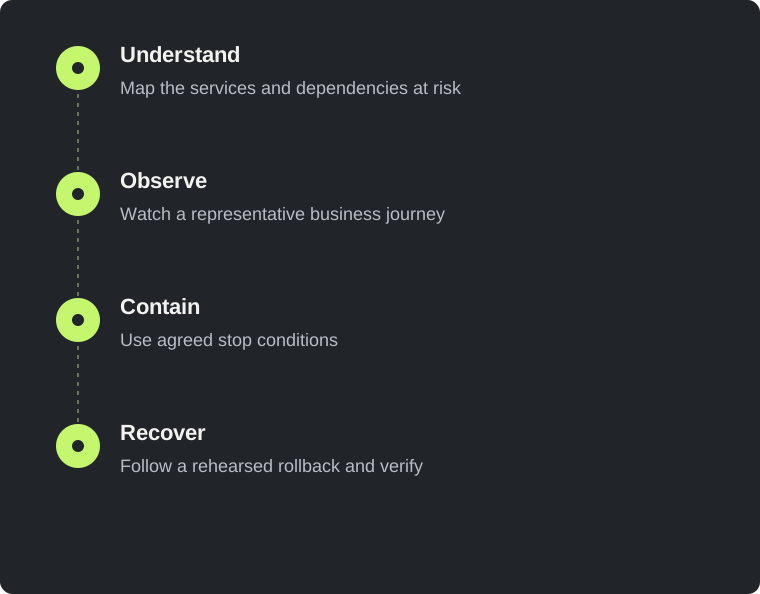
- Understand
Map the services and dependencies at risk
- Observe
Watch a representative business journey
- Contain
Use agreed stop conditions
- Recover
Follow a rehearsed rollback and verify
Monitoring must see more than the device
A device can be powered on and answering management requests while the business service behind it is failing. Component checks remain useful, but they should sit beside representative service checks. For a customer portal, that might mean loading the sign-in page, authenticating a synthetic account and retrieving a harmless test record. For an internal system, it might mean confirming that the staff workflow still completes.
Assign an observer whose job is to watch those outcomes while someone else performs the change. In a small company, the same two people may cover many roles, but separating execution from observation during a sensitive window still helps. Agree how they will communicate if the main network or chat platform becomes unavailable. A monitor that sends alerts through the affected path may be unable to tell anyone that it has failed.
Keep a baseline from before the change. Error rates, latency, connection counts and traffic volume become more meaningful when compared with expected conditions. A sudden increase may be a symptom worth investigating even before customers complain. Avoid improvising thresholds during the incident; define the decision rule while the team has time to consider the consequences. The goal is to make stopping a change a planned action, not a personal judgment about whether the implementer has tried hard enough.
Design rollback before the first command
“We will roll back if necessary” is not yet a rollback plan. The plan should identify the last known configuration, the person authorized to restore it and the access route they will use. It should also explain whether the old state remains technically compatible after the change. Some migrations alter data or dependencies in ways that make a simple reversal unsafe.
For a network change, preserving configuration and access may be central. For an application deployment, the team may need to account for new database fields, queued jobs and clients running different versions. For an identity change, it may need a separately controlled administrative route. The details differ, but the question is consistent: what must remain available for recovery, and have we confirmed that it will?
Time matters as well. Set a point at which the team stops diagnosing and restores the previous state, unless a clearly authorized person decides otherwise. A maintenance window can disappear while people pursue one promising theory after another. Record the reason when the plan changes, and communicate the new expectation to affected teams. This creates accountability without turning every difficult technical decision into a blame exercise.
Put the basic change checks into a repeatable preflight
The following Python example is a deliberately small local check for a change record. It verifies that some essential planning fields are present and that the rollback rehearsal is recent enough for the team's chosen policy. It does not connect to a device, approve a change or establish that the procedure is technically safe. It illustrates how routine completeness checks can become consistent rather than dependent on someone's memory.
The policy values are examples, not universal requirements. A company should choose a review interval that fits the rate of change and the criticality of the service. More importantly, the referenced runbook and rehearsal evidence must exist and be useful. A field containing a convincing filename is not proof that anybody has successfully restored the system. Automation can flag missing information; people still need to judge the evidence.
Integrate a check like this into the place where the team already proposes infrastructure changes. Keep the record short enough to maintain and require additional detail where the risk warrants it. If every routine change requires a sprawling document, people will learn to copy an old one without reading it. A few clear, verified facts often provide a stronger foundation than pages of boilerplate.
from datetime import date

REQUIRED = ("owner", "service", "rollback_runbook", "stop_condition")

def check_change(change, today, max_rehearsal_age_days=30):
    issues = [f"Missing {key}" for key in REQUIRED if not change.get(key)]
    try:
        rehearsed = date.fromisoformat(change["rollback_rehearsed"])
        age = (today - rehearsed).days
        if age < 0 or age > max_rehearsal_age_days:
            issues.append("Review the rollback rehearsal date")
    except (KeyError, TypeError, ValueError):
        issues.append("Supply a valid rollback rehearsal date")
    return issues

example = {
    "owner": "platform-team",
    "service": "staging-customer-portal",
    "rollback_runbook": "runbooks/restore-gateway.md",
    "stop_condition": "Synthetic sign-in fails twice",
    "rollback_rehearsed": "2026-11-12",
}
print(check_change(example, date(2026, 11, 19)))Limit how far abnormal behaviour can travel
A useful design question is whether one component can consume shared resources needed by unrelated services. A background worker might exhaust a database connection pool. A noisy integration might fill a queue used by payment processing. A network device might affect traffic beyond the segment its operator was thinking about. These are general examples of shared dependency risk, not claims about the FAA's internal architecture.
Possible controls include separating workloads, limiting concurrency, setting appropriate rate limits and keeping recovery capacity available. Each control needs to be designed for the actual protocol or application. An arbitrary limit can block legitimate work, while an overly generous limit may provide little containment. Measure normal behaviour, test representative bursts in an authorized environment and document what happens when the limit is reached.
The business decision is about tradeoffs. Sharing infrastructure is often economical and sensible, especially for a young company. The problem is unmanaged sharing that nobody can explain. Identify the few dependencies whose failure would stop several important functions, and spend attention there first. The objective is not to build isolated infrastructure for every minor feature; it is to prevent one low-priority activity from unexpectedly taking the core business with it.
A contractor can execute the work; the business still owns the outcome
External specialists bring valuable expertise, but the handoff between a provider and the organization deserves deliberate attention. Who confirms that the environment is ready? Who knows which customer commitments overlap the maintenance window? Who watches the downstream service? Who can stop the work? If both sides assume the other has those responsibilities, the most important controls may exist only as assumptions.
Use a shared change record that names the implementer, the observer and the decision owner. Agree the communication route, start conditions and evidence required before declaring completion. Where access is temporary, include its removal in the closure criteria. These are practical coordination measures, not a claim that a contractor is inherently less trustworthy than an employee. Internal handoffs can fail in exactly the same way.
For agencies and managed-service customers, ask for a clear description of the work and its expected impact before approving it. You do not need to become an expert in every device. You do need to understand the business functions at risk and the recovery path. If the provider cannot explain those points in understandable language, resolve that gap before the maintenance window begins.
Know when stopping is the right outcome
Some degraded states are acceptable; others create uncertainty that the business should not pass to customers. A payment service that cannot determine whether a charge succeeded should not invite repeated submissions without safeguards. A dispatch system with stale delivery instructions may need a controlled pause. The decision should follow the consequences of acting on uncertain information, rather than a blanket rule that keeping the interface available is always better.
Agree those states with the people who run the business. Engineering can explain the failure modes, but operations and support understand what happens when a customer receives the wrong confirmation or a staff member acts on an outdated record. Build a short decision table that describes the safe action, the customer message and the person who can authorize a return to normal operation.
During an incident, communicate the current effect and the next update time. Avoid speculation about attackers, blame or restoration deadlines. If the cause is unknown, say so. A clear statement that a feature is paused while the team verifies transaction status is more useful than a confident explanation that later proves wrong. Afterward, retain the messages as part of the timeline so that the response itself can be reviewed.
Rehearse a small failure before confronting a large one
A rehearsal does not need to disrupt production to be valuable. Start with a tabletop exercise using a realistic scenario: a routine network change leaves the customer portal intermittently unavailable, the main chat service is unreliable and the usual administrator is away. Ask the team to walk through detection, authority, recovery and communication. Time the steps that require finding information or another person.
Follow with a controlled technical exercise in an appropriate environment. Verify that the saved configuration can be restored, that the synthetic journey detects the expected failure and that the observer can reach the implementer through the agreed alternative channel. Use synthetic data and written limits. A rehearsal intended to improve availability should not quietly become unapproved stress testing of a live service.
Close the exercise with a few specific improvements. Replace “improve monitoring” with a named customer journey and a measurable alert. Replace “document rollback” with a runbook that another team member has followed successfully. Assign an owner and a review date. The exercise has value when it changes what the next responder can do, not when it merely produces a completed checklist.
Where this belongs in a security conversation
Security includes protecting the ability to use a service, but different questions require different kinds of assessment. A penetration test can investigate whether an unauthorized person can alter a configuration, abuse a management interface or bypass a permission boundary. A resilience exercise investigates whether the service can tolerate a failure and recover within the business's objectives. Neither result automatically answers the other question.
A free external review of one approved domain can identify visible exposure and help scope a deeper web or API assessment. It cannot validate an entire operational network, guarantee that a supplier's update is safe or establish that a recovery plan works. Being clear about that distinction helps a business buy the work it actually needs and judge whether the resulting evidence supports its decisions.
The most useful takeaway from this story is a question to bring to the next change review: if this component behaves unexpectedly, how will we detect it, contain it and reverse the change? Answer it for one important service before expanding the exercise. That discipline scales from a small startup to a much larger organization, because it turns an abstract concern about outages into a practical plan for the people who will have to respond.
Sources & editorial notes
This analysis uses public reporting and the sources below. Confirmed facts are distinguished from our recommendations and hypothetical examples. We did not investigate these organisations’ systems. Code examples are educational and should be adapted and tested in an authorised environment.
- US Department of Transportation — ground-stop investigation update, 17 November 2026
Primary official account. Precise root cause remained under investigation in this update; reviewed 19 November 2026.
Incident accounts can change as investigations develop. This article reflects sources checked on 19 November 2026. Illustrations are conceptual; no affiliation or endorsement is implied.