
What to take away
- A low-trust customer portal should not inherit the authority to publish software to customer machines.
- An update’s familiar delivery channel does not prove the release process remained trustworthy.
- Recovery must address exposed credentials and established access, not only remove the malicious file.
The dangerous journey from customer account to update publisher
OPSSHIELD’s 3 November 2026 disclosure describes an attacker entering its billing and licensing environment after registering as a customer, obtaining publishing credentials and distributing a malicious cPGuard update. The reported activity spanned 1–2 November. The company said roughly 2,950 customer servers ran the update, which collected sensitive files and left unauthorized access components. Its retained logs did not identify the exact request that produced initial access. [1]
That last limitation matters. The disclosure supports a sequence of compromised systems and stolen authority, but it does not justify inventing a particular injection flaw or presenting a speculative exploit as established fact. The useful lesson is the crossing of boundaries: a customer-facing business application became a route toward software running with substantial privilege on customer machines. [1]
For a hosting company or SaaS startup, this is an uncomfortable but valuable scenario to examine. The application that takes payments or manages licenses may seem separate from the product’s security. In practice, credentials, shared accounts and administrative shortcuts can connect them. A problem in the surrounding business systems can therefore have consequences far beyond the web page where it began.
This article focuses on those design decisions and the questions customers can ask suppliers. It does not provide an attack recipe, claim to reproduce the incident or replace the vendor’s current response guidance. The examples are defensive and illustrative. Their purpose is to help a business understand which systems are allowed to make changes to other people’s infrastructure.
Security software still needs a security boundary
A security product often needs visibility that ordinary applications do not. It may inspect files, observe processes or change system configuration. Those capabilities can be useful, but they make the product’s update path especially consequential. The important question is not whether security tools are inherently unsafe; it is how their authority is controlled and what evidence establishes that an update is legitimate.
Think of trust as several separate decisions. You trust a vendor to maintain a useful product. You trust a release process to build the intended code. You trust a distribution channel to deliver that release. Your machine then decides whether to execute it. If all these decisions collapse into “the file came from the usual URL,” a compromise of that delivery path can undermine the other assumptions.
For a small company, this does not mean manually reading every line of every update. It means asking proportionate questions about high-privilege software. How are releases authorized? Which credentials can publish them? How are signatures or provenance verified? Can the supplier stop distribution quickly? What information will customers receive if the process becomes untrustworthy? A credible answer should explain the mechanism, not rely solely on the product’s security branding.
Keep the same discipline for internal software. An agent your own team deploys to customer servers deserves a controlled release process even if the company is small. Growth increases the consequence of shortcuts: a publishing account that once affected two test machines may later reach hundreds of customer systems. Review the authority as the product changes, rather than assuming the original development arrangement remains appropriate.
Separate customer-facing systems from release authority
Consider a hypothetical startup with a billing portal, a license service and a downloadable agent. Customers need to view invoices and retrieve license status. The release pipeline needs to publish approved agent builds. Those functions may belong to the same business, but they do not require the same permissions. Start by documenting which specific operation each component must perform.
The billing application might need to update subscription records without being able to replace software artifacts. The license service might need to answer whether a subscription is active without reading a deployment credential. A release job might need temporary permission to publish one approved package while having no access to customer payment details. These are design goals to validate against the application’s actual needs, not assumptions about OPSSHIELD’s architecture.
Look for indirect connections as well as explicit credentials. Shared administrator accounts, common deployment runners, backup scripts and broad cloud roles can join systems that appear separate in a diagram. A compromise of one application may expose configuration belonging to another if they share a host or accessible storage. Ask what an application identity can reach after it has performed its normal business task.
Then remove unnecessary authority and verify the result. A policy document that says “billing cannot publish” is weaker than a tested permission boundary showing that the billing identity cannot write to the release location. Review denial behavior as well as successful operations. The aim is to make an application compromise less able to become a distribution compromise, even while you work to prevent the initial application flaw.
Separate the trust decisions in a software release
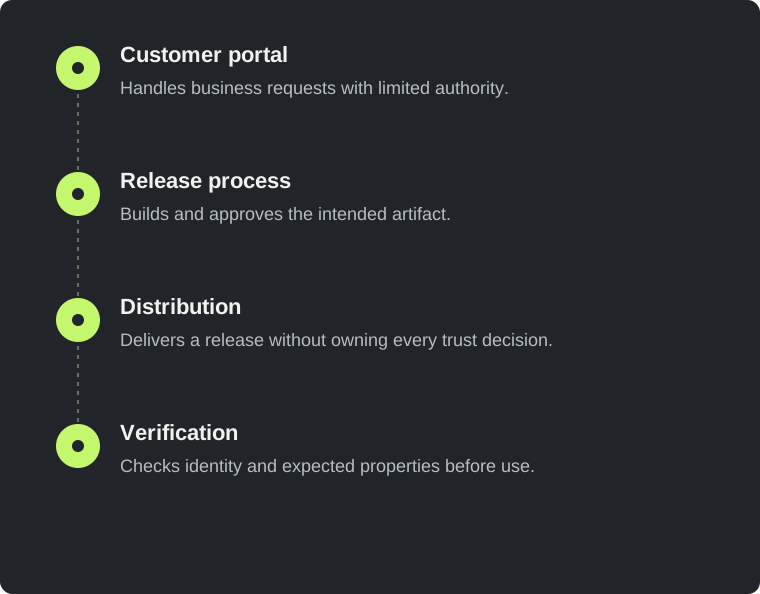
- Customer portal
Handles business requests with limited authority.
- Release process
Builds and approves the intended artifact.
- Distribution
Delivers a release without owning every trust decision.
- Verification
Checks identity and expected properties before use.
A checksum is useful, but it is not a trust policy
A cryptographic hash can tell you whether a file matches a particular expected value. It cannot tell you whether the person providing that expected value is trustworthy. If an attacker can replace both a download and the checksum displayed beside it, comparing the two may confirm only that the attacker changed them consistently. This distinction is fundamental when discussing supply-chain security.
A stronger release process establishes who produced the artifact and which properties the consumer expects. SLSA’s verification guidance includes checking provenance signatures, trusted builder identity and expected build parameters. [2] Implementing those checks requires a trust configuration appropriate to the product and ecosystem. Merely generating an attestation without verifying it at the point of use does not complete the control.
The Python example below is deliberately narrower. It compares a local file with a SHA-256 value supplied through a separately authenticated process. It makes no network request and does not execute the file. Python’s standard hashing library supplies the calculation. [3] A match is an integrity result relative to the supplied value, not proof that the software is benign or that the publisher’s release process was uncompromised.
Use this distinction when evaluating a supplier’s answer. “We publish checksums” and “customers verify signed releases against a protected trust root” describe different controls. Both may have a place, but neither should be described more broadly than it operates. Ask what happens when publishing credentials are stolen and which independent boundary would still prevent an unauthorized release from being accepted.
import hashlib
import hmac
import re
import sys

if len(sys.argv) != 3:
    raise SystemExit("Usage: verify_file.py FILE EXPECTED_SHA256")
path, expected = sys.argv[1:]
if not re.fullmatch(r"[0-9a-fA-F]{64}", expected):
    raise SystemExit("Expected a 64-character SHA-256 digest")

digest = hashlib.sha256()
with open(path, "rb") as artifact:
    for chunk in iter(lambda: artifact.read(1024 * 1024), b""):
        digest.update(chunk)

if not hmac.compare_digest(digest.hexdigest(), expected.lower()):
    raise SystemExit("Mismatch: stop and investigate")
print("File matches the supplied digest; authenticity is a separate check.")Make publishing an accountable operation
Publishing software to customers should have a clear identity, purpose and audit trail. Avoid reusing the same broad credential across a developer laptop, a billing server and a release pipeline. Where the platform supports it, consider short-lived, narrowly scoped release credentials and protected approval steps. The exact implementation depends on the service, but the principle is to reduce both the number of places holding authority and the duration of that authority.
Decide who can change the release workflow itself. Protecting the final publish button is not enough if an unrelated application can modify the job that builds the package or the policy that approves it. Review the source repository, build environment, artifact storage and deployment configuration as one process with distinct boundaries. Each should have a documented reason for the permissions it receives.
Keep release evidence that can be examined independently of the downloaded binary. Useful records include the approved source revision, build identity, artifact digest, approval event and publication time. These records help investigate whether an unexpected file came from the intended process. They are also useful during ordinary support, when a customer needs to establish which release is actually installed.
Practice stopping distribution and revoking release authority. An emergency procedure should identify who can act and what downstream services will be affected. Do not wait until an incident to discover that the only person who can revoke a publishing credential is unreachable. A controlled exercise using a test channel can reveal the dependency without putting customer machines at risk.
What a customer can do without rebuilding the supplier
A customer cannot directly fix a vendor’s internal release architecture, but it can make deliberate decisions about the software it installs. Maintain an inventory of agents and their privileges. Identify which products update automatically, which person receives security notices and how quickly the team can determine the installed version. These basic records reduce the time spent guessing during a response.
Choose update policies according to the product and the business consequence. Indefinitely postponing security updates creates its own risks. A staged rollout may help detect operational problems, but it does not guarantee detection of malicious behavior. The appropriate balance should consider vendor guidance, exposure, available testing and the organization’s ability to respond. There is no single delay interval that makes every update safe.
Monitor high-privilege software as part of the host’s normal security controls. A familiar process creating unexpected accounts or reaching unusual destinations deserves review in context. Do not assume that a product is outside monitoring merely because its purpose is security. Equally, avoid treating every new file as proof of an attack; legitimate updates change systems, so the investigator needs version and release information.
Ask the supplier how customers can verify legitimate guidance during an incident. Use established support routes rather than links in an unexpected email. Keep contact details and product ownership records accessible if the primary portal is unavailable. A business that knows exactly which systems use the product can make a targeted response instead of applying disruptive changes everywhere out of uncertainty.
Removing a malicious update may leave other work unfinished
If sensitive credentials may have been copied, deleting the file that collected them does not revoke the copied values. Recovery needs to consider what authority those credentials provide and where else they are accepted. This is why an incident involving a privileged agent can extend beyond the machine on which it ran. A database password, cloud key or SSH identity may connect to another system entirely.
Create a credential dependency map during response. Record the identity, the resources it can access, where it is used and who can replace it. Do not copy the secret itself into a shared incident document. Sequence changes so essential services can recover safely, and use a trusted administrative environment. Rotation performed from a device still under attacker control may fail to establish the boundary you intended.
Investigate established access as a separate question. An attacker may have added accounts, keys, scheduled tasks or another management tool. Whether rebuilding is necessary depends on the evidence and the ability to establish system integrity. Follow current vendor guidance and the organization’s incident-response lead rather than treating an online cleanup checklist as universal proof of recovery.
Verification should include both technical checks and business behavior. Are the intended services running? Have old credentials stopped working in the systems that trusted them? Are unexpected access paths removed? Are logs available to support the conclusion? Record what remains uncertain. Restoring normal operation is important, but it should not quietly replace the question of whether the environment can now be trusted.
Review the surrounding business applications too
A supplier security review often concentrates on the flagship product while overlooking the customer portal, licensing service and support integrations around it. Those systems handle identities and business information, and sometimes hold authority over the product itself. Include them in the architecture conversation. Ask which of them can change releases, issue licenses, retrieve customer secrets or trigger actions on customer infrastructure.
For a startup building its own product, map the same relationships before commissioning a pentest. A narrowly scoped test of the marketing website will not answer whether the billing application can reach a release bucket. Define the assets and identities that matter, then decide which boundaries can be tested safely. Written authorization is especially important when customer machines or third-party infrastructure are involved.
Use findings to improve separation, not only patch an individual entry point. Fixing an application defect is necessary when one is found, but broader permissions may allow the next unrelated defect to produce a similar consequence. Ask what the compromised component was able to reach and whether that access was required. This turns an isolated fix into a more durable reduction in the system’s authority.
Keep the review proportional. A small company may begin with a diagram, a permission inventory and a few targeted tests of high-consequence paths. The value comes from resolving important assumptions, not from producing the longest possible checklist. A well-chosen boundary test can be more useful than a large scan report that never examines how the company actually ships software.
Begin with the boundary you can explain
The most useful question after a supply-chain incident is often: which system in our business can make a change that other systems automatically trust? That might be a release pipeline, an integration account or an administrator portal. Name the authority, identify its owner and document what prevents a less-trusted component from obtaining it.
A free external review of one approved domain can help identify visible exposure and questions worth investigating. It cannot validate an entire software supply chain or certify a vendor’s release process. A deeper assessment needs an agreed scope covering the relevant applications, identities and environments. The distinction should be clear before work starts.
Security tools remain useful, and software still needs updates. The practical response is to make trust specific and verifiable: controlled publishing authority, an understood verification process, evidence of what ran and a recovery plan for the credentials and systems affected. Those controls give a business more than a familiar logo to rely on when the update channel itself becomes the subject of an incident.
Sources & editorial notes
This analysis uses public reporting and the sources below. Confirmed facts are distinguished from our recommendations and hypothetical examples. We did not investigate these organisations’ systems. Code examples are educational and should be adapted and tested in an authorised environment.
- OPSSHIELD: Security Incident Disclosure, manage.opsshield.com
Updated 3 November disclosure. More detailed than the earlier cPGuard update-channel advisory; the exact initial exploit was not established from retained requests.
- SLSA: Verifying artifacts
Background on checking provenance, trusted builders and expected build properties.
- Python documentation: hashlib
Standard-library reference for the local file-integrity example.
Incident accounts can change as investigations develop. This article reflects sources checked on 19 November 2026. Illustrations are conceptual; no affiliation or endorsement is implied.